Parts of a Fireplace and Chimney, Explained
A masonry fireplace is a dozen separate parts doing one job: burn fuel safely and get the smoke out. Here is what each piece is called, what it does, and what goes wrong with it — from the hearth at your feet to the cap forty feet up.
Most people only learn these names when something stops working. A chimney sweep says your smoke chamber needs parging, or an inspector writes up a cracked flue liner, and suddenly there is a bill attached to a word you have never heard.
This page is the plain-English version. Work top to bottom or bottom to top — smoke travels up, so we will follow it.
The Fireplace Itself
Hearth
The floor of the fireplace, and the fireproof surface extending into the room. The part inside is the inner hearth; the part you can stand on is the hearth extension. Code requires that extension for a reason — it catches rolling logs and popping embers. On a standard opening it must reach at least 16 inches into the room and 8 inches past each side.
What goes wrong: cracked or loose hearth brick, and extensions that were shortened during a remodel and no longer meet code.
Firebox
The chamber where fuel burns. A masonry firebox is built from firebrick laid in refractory mortar — not the common brick and standard mortar used on the outside of your house. Firebrick tolerates direct flame and repeated heat cycling; common brick spalls and crumbles under it.
What goes wrong: open joints between firebrick, cracked or missing units, and the classic mistake of a previous repair done in regular mortar, which fails within a season or two. Gaps in the firebox let heat reach framing behind the masonry, which is a genuine fire risk rather than a cosmetic problem.
Lintel
The steel angle spanning the top of the fireplace opening, carrying the masonry above it. Same principle as the lintel over a garage door — a steel beam holding up brick.
What goes wrong: rust. Steel expands several times its own thickness as it corrodes, and that pressure cracks the brick course sitting on it. See our lintel definition for the short version.
Ash dump and ash pit
A small cast-iron door in the hearth floor that drops ash into a masonry chamber below, cleaned out through a door in the basement or on an exterior wall. Common in older Memphis homes, frequently sealed shut in newer ones.
What goes wrong: rusted-through dump doors, and ash pits that were never emptied and have filled to the point that the dump no longer works.
Throat, Damper, Smoke Shelf and Smoke Chamber
Everything between the firebox and the flue exists to do one thing: turn a wide, hot fire into a narrow, fast-moving column of smoke. It is the least visible part of the system and the source of most draft complaints.
Throat
The narrowed slot directly above the firebox. Squeezing the opening speeds the smoke up — the same reason you put a thumb over a hose. A throat that is too wide or too low is a leading cause of a fireplace that smokes into the room.
Damper
The metal plate that opens and closes the throat. Open it before you light a fire; close it when the fireplace is cold to stop heated air escaping up the chimney. A damper at the throat is the traditional location. A top-sealing damper sits at the very top of the flue instead and seals with a gasket, which stops far more air loss and keeps rain and animals out.
What goes wrong: rusted or warped plates that will not close, broken handles, and dampers rusted open by years of water coming down an uncapped flue. A damper that will not seal is a hole in your roof that you pay to heat around.
Smoke shelf
The flat ledge behind the damper. Its job is to catch downdrafts — cold air pushing down the flue — and turn them back upward before they can shove smoke into your living room. It also catches whatever rain and debris come down the chimney.
Smoke chamber
The tapered space above the smoke shelf that funnels the full width of the firebox down to the much smaller flue. It should be parged — coated smooth with refractory mortar — so smoke slides up rather than tumbling over rough corbelled brick.
What goes wrong: this is the single most commonly defective component we find. Many were never parged at all, leaving stair-stepped brick that creates turbulence, slows the draft and collects creosote. Parging a rough smoke chamber often fixes a smoking fireplace that no amount of damper adjustment would.
Flue, Liner, Crown and Cap
Flue and flue liner
The flue is the passage the smoke travels up. The liner is the surface of that passage — usually stacked clay tiles in a masonry chimney, or a stainless steel pipe in a relined one. The liner does two jobs: it contains heat so it never reaches framing, and it protects the brick from acidic combustion gases that eat mortar from the inside.
What goes wrong: cracked or shifted clay tiles, and older chimneys that were built with no liner at all. A cracked liner is a safety defect, not a maintenance item — it is one of the main things a Level 2 inspection is looking for. See chimney relining for how it is fixed.
Chimney crown
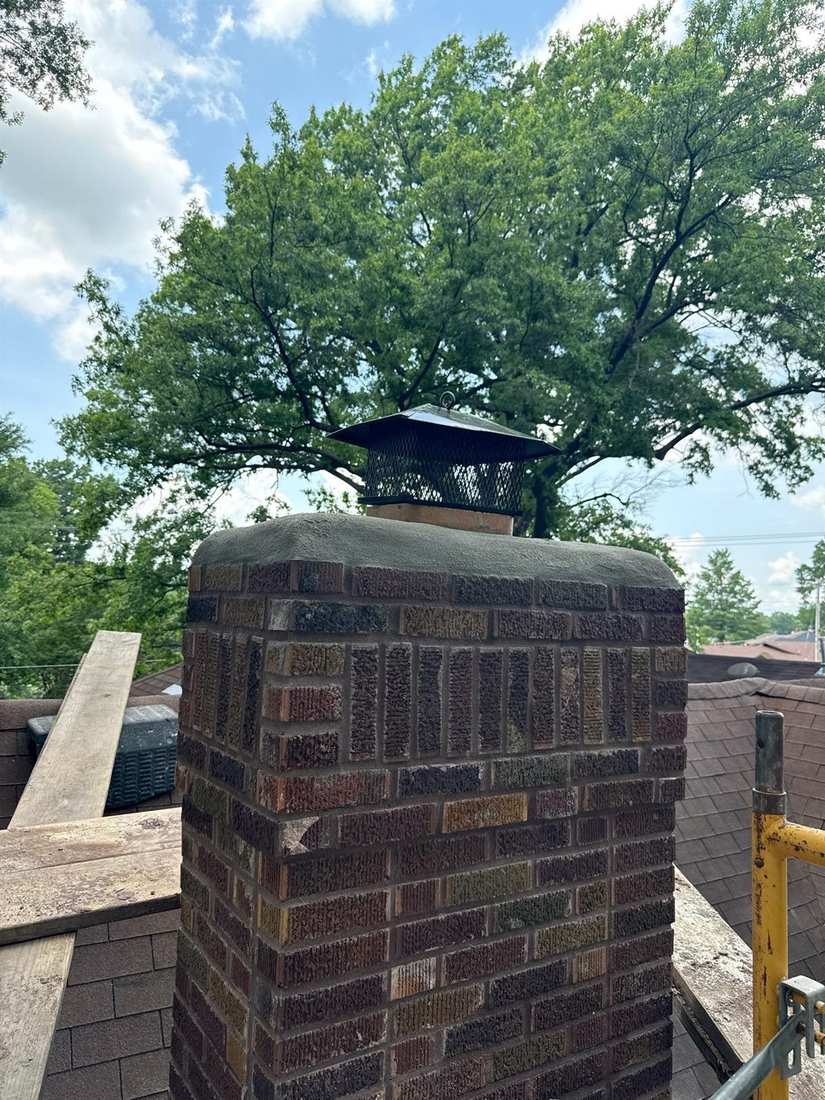
The concrete slab across the top of the masonry, sloped to shed water away from the flue. Not to be confused with the cap. A proper crown is poured concrete with an overhang and a drip edge — not a thin smear of mortar, which is what most failed crowns turn out to be.
What goes wrong: cracking straight through, then water into the brick below and freeze-thaw damage every winter. This is the number one entry point for chimney leaks. Our chimney repair guide shows a crown rebuild start to finish.
Chimney cap
The metal cover over the flue opening, usually with mesh sides. A cap keeps rain, birds, squirrels and leaves out of the flue, and the mesh acts as a spark arrestor so embers do not land on your roof.
What goes wrong: rusted-through caps, caps blown off in storms, and chimneys that never had one. An open flue is a drain pointed directly into the heart of your chimney.
Flashing
The metal seal where the chimney passes through the roof. Flashing is layered in two parts — step flashing woven into the shingles, counter-flashing let into a mortar joint and lapped over it.
What goes wrong: corroded metal, and flashing that was surface-caulked instead of cut into the masonry. It is the second most common source of chimney leaks after the crown, and the two are constantly confused because they produce the same ceiling stain.
Crown or flashing? They leak the same way
A stain on the ceiling beside the chimney tells you water is getting in. It does not tell you where. Finding out is the entire point of an inspection — and it is why homeowners sometimes pay a roofer to fix a masonry problem, or a mason to fix a roofing one.
Most of This Is Only Visible From the Roof
A cracked smoke chamber, a rusted damper and a failed crown are three of the most common findings in our inspections, and not one of them can be diagnosed from the hearth. Every chimney repair estimate includes 4K drone photos of the crown, cap and flashing — the outside only, and you see the photographs yourself. A written inspection is a different service: we sweep the flue first ($200) so we can see inside and issue the report.
Family-owned in Memphis since 1982. Licensed, insured, and a 10-year guarantee on the work.
Related: firebox & flue repair · chimney repair guide · chimney inspections · full masonry glossary
Ready to Protect Your Home? Let's Talk.
From a crumbling chimney to a hairline mortar crack, Madewell Masonry gives you an honest assessment and a fair price — backed by 40+ years of experience and a 10-year guarantee on our workmanship.